Table of Contents
Introduction
The JF-17 Thunder, jointly developed by Pakistan and China, has emerged as one of the most discussed and strategically important fighter aircraft in recent years. Following heightened Pakistan–India military tensions, the aircraft has gained unprecedented global attention. Its growing export footprint, cost efficiency, and modern combat capabilities have positioned it as a serious contender in the international defense market. Today, the JF-17 Thunder is not only a symbol of Pakistan’s defense self-reliance but also a preferred option for several developing and mid-tier air forces worldwide.
Background: Pakistan–China Defense Collaboration
The JF-17 program was initiated to meet Pakistan Air Force’s need for a modern, affordable, and multi-role fighter jet that could replace aging aircraft fleets. Developed by Pakistan Aeronautical Complex (PAC) and Chengdu Aircraft Corporation of China, the project ensured technology transfer, local manufacturing, and long-term sustainability.
This collaboration allowed Pakistan to gain:
- Indigenous production capability
- Freedom from Western political restrictions
- Control over upgrades and weapons integration
Impact of Pakistan–India Tensions on JF-17 Visibility
After periods of Pakistan–India military confrontation, global analysts and defense observers closely examined Pakistan’s air power. The JF-17 stood out due to its operational readiness, rapid deployment capability, and integration with modern air combat doctrine.
These events:
- Increased international media coverage
- Demonstrated real-world deterrence capability
- Boosted confidence among potential buyers
As a result, the aircraft’s reputation expanded beyond South Asia.
Global Demand and Export Success

Pakistan has successfully exported the JF-17 Thunder to multiple countries, enhancing its global credibility.
Key Export Destinations
- Myanmar – Operational deployment in national air force
- Nigeria – Combat-ready variants delivered and inducted
- Azerbaijan – Strategic defense cooperation and procurement
Additionally, interest from countries like Bangladesh, highlighted by visits from senior military leadership, reflects growing regional confidence in the platform.
This export success proves that the JF-17 meets international operational standards, not just domestic requirements.
Why JF-17 Thunder Is So Important
1. Cost-Effective Fighter Jet
One of the strongest advantages of the JF-17 Thunder is its low acquisition and operational cost.
- Estimated unit cost: USD 25–30 million
- Significantly cheaper than Rafale, F-16, or Gripen
- Lower maintenance and lifecycle costs
This makes it ideal for countries seeking maximum capability within limited defense budgets.
2. Advanced Features and Modern Technology
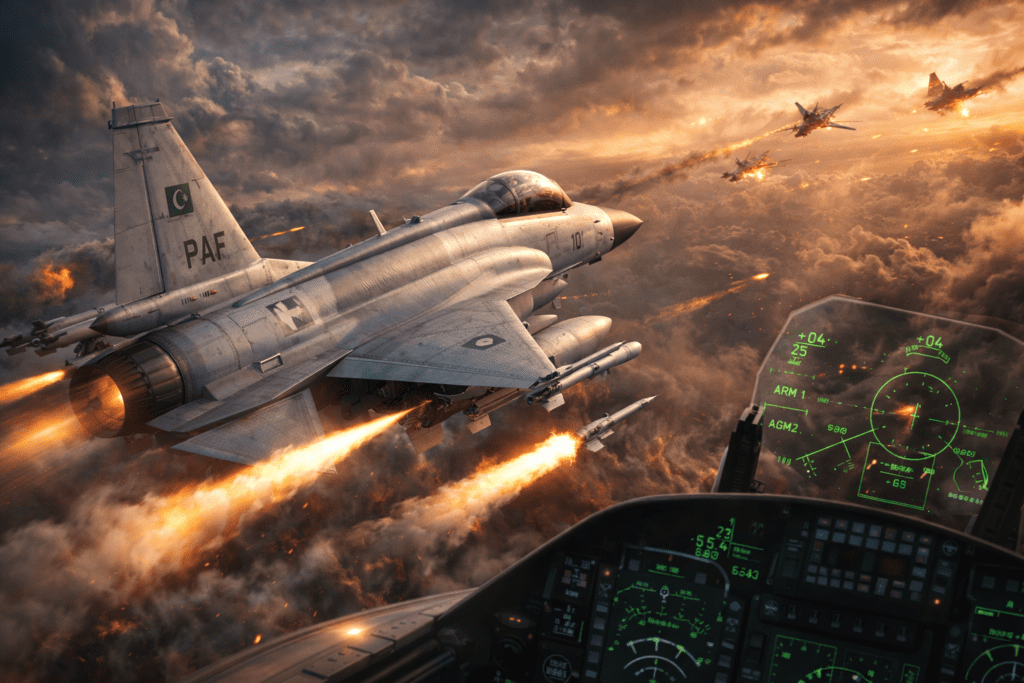
The latest variants, especially Block-III, include features comparable to advanced fourth-generation fighters:
- AESA radar
- Helmet-mounted display (HMD)
- Advanced electronic warfare suite
- Data link and network-centric warfare capability
- Precision-guided munitions
These features make the JF-17 Thunder a modern battlefield-ready aircraft.
3. Multi-Role Combat Capability
The aircraft is designed for versatility. It can perform:
- Air-to-air combat
- Air-to-ground strike missions
- Maritime strike operations
- Reconnaissance
This multi-role nature reduces the need for multiple aircraft types, saving costs for air forces.
Comparison With Other Fighter Jets
When compared to Western fighters, the JF-17 Thunder may not aim to surpass high-end stealth jets, but it excels in cost-to-performance ratio.
Why Countries Prefer It
- No political strings or sanctions risk
- Flexible weapons integration (Chinese, local, and compatible systems)
- Easier pilot training and maintenance
- Reliable supply chain
For many countries, it offers “good enough capability at the right price”, which is often more important than elite performance.
Strategic and Political Advantages
Beyond technology, Pakistan offers:
- Defense cooperation
- Training and technical support
- Long-term maintenance partnerships
This holistic defense package makes the JF-17 Thunder more attractive than competitors that offer only the aircraft.
Conclusion
The JF-17 has earned its global importance through a combination of affordability, modern combat features, operational reliability, and strategic independence. After Pakistan–India tensions, the aircraft gained international visibility, proving its relevance in real-world security dynamics. Its growing exports, continuous upgrades, and flexible deployment options explain why many countries now prefer it over more expensive alternatives.
In today’s evolving defense environment, the JF-17 Thunder represents a practical, capable, and strategically smart choice—not just for Pakistan, but for air forces across the world.
-
Which precious metal is used in JF-17 Thunder?
The JF-17 Thunder does not use precious metals in large amounts, but it contains small quantities of high-value metals essential for performance.
Titanium is used in the airframe and engine due to its strength and heat resistance.
Gold and silver are used in avionics, radar, and electronic connectors for reliable conductivity.
Trace platinum-group metals are used in sensors and advanced electronic systems. -
How capable is the J-17 Thunder fighter aircraft in comparison with other fourth generation aircrafts like Tejas, F-16, MiG-35, and Miig-29?
The JF-17 Thunder is a cost-effective fourth-generation fighter with modern avionics and strong multi-role capability, though it is less powerful than heavier jets like the F-16 or MiG-35.
Compared to Tejas, it offers broader weapons integration and proven export success.
Against MiG-29, it is cheaper and easier to maintain but has lower raw thrust and agility.
Overall, the JF-17 emphasizes affordability, upgrade flexibility, and operational practicality rather than top-tier performance. -
Why is the JF-17 Thunder important for Pakistan?

The JF-17 Thunder is important because it gives Pakistan a modern, multi-role fighter jet produced with local participation.
It reduces dependence on Western suppliers and political restrictions.
The aircraft also strengthens Pakistan’s air defense through continuous upgrades and self-reliance. -
How much does a JF-17 Thunder fighter jet cost?
The estimated unit cost of a JF-17 Thunder is around USD 25–30 million, depending on the variant.
Its operational and maintenance costs are also significantly lower than Western fighters.
This affordability makes it suitable for air forces with limited defense budgets. -
Which countries are operating or buying the JF-17 Thunder?
The JF-17 Thunder is currently operated by Pakistan, Nigeria, Myanmar, and Azerbaijan.
Several other countries have shown interest due to its performance and price.
Its successful exports have increased global confidence in the aircraft. -
How does JF-17 Thunder compare with other fourth-generation fighter jets?
Compared to heavier fighters, the JF-17 Thunder offers slightly less raw power but greater affordability.
It performs well in multi-role missions with modern avionics and weapons integration.
For many countries, it provides the best balance between capability and cost. -
Is the JF-17 Thunder a modern and future-ready fighter aircraft?
Yes, especially the Block-III version, which includes AESA radar and advanced electronic warfare systems.
It supports network-centric warfare and modern combat doctrines.
Ongoing upgrades ensure the aircraft remains relevant in future conflicts.